Charlie Gibbs
The Robot Who Looked Like MeCharlie Gibbs is Washburn’s friend and the SAG representative responsible for explaining the institutional stakes of Washburn’s threatened final shootout. His importance lies in the way he occupies both sides of the boundary between private loyalty and professional obligation: he offers Washburn candid counsel, but cannot promise that the Guild will protect him from a contract made on his behalf. In a story where performers are also watched by audiences and expected to live their roles, Charlie Gibbs makes the costs of stepping offstage explicit.
Identity and Two Roles
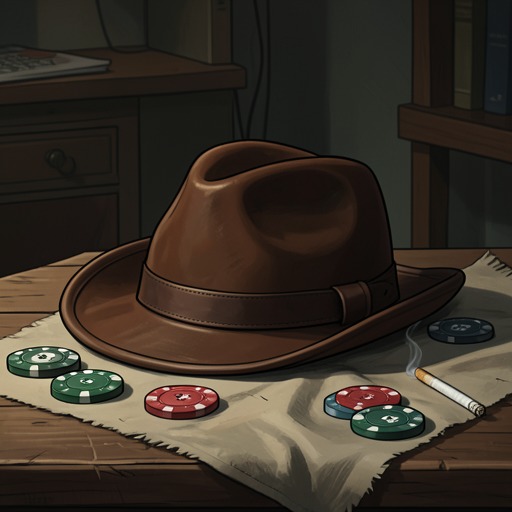
Charlie Gibbs works as a SAG representative and spends considerable time hearing performers’ complaints and grievances. His office is not a conventional workplace: it is the Comanche outhouse, a designated off-camera area where conversations can take place outside the Western setting. Hidden air conditioning and cigarettes stored behind a beam make the space more comfortable, while its separation from the visible set allows the characters to discuss matters that do not belong to their fictional town.
That division is practical, but not absolute. Charlie Gibbs knows the Western world well enough to speak in the manner of a friend who has spent years around Washburn, while his Guild position requires him to explain the rules governing the performers’ work. When Washburn approaches him, he specifically appeals to the old friend rather than the representative. Charlie Gibbs accepts that distinction, but the conversation soon shows its limits: friendship can shape his advice, not erase the contract or the Guild’s policy.
The Contract and Its Stakes
Washburn comes to Charlie Gibbs wanting to know why Little Joe Potter is expected to take his derby. Charlie Gibbs explains that Potter is a rising star and that, after Jeff Mangles was killed, matching Potter with Washburn for a shootout seemed natural. Potter agreed to the arrangement. Washburn’s own agent-manager, Gordon Simms, was approached the previous day and renegotiated Washburn’s contract, securing a substantial bonus for the shootout appearance.
The arrangement was made without Washburn’s prior approval. Charlie Gibbs says Washburn was unavailable when Simms handled the negotiation, and that Simms represented the decision publicly as something Washburn had long wanted: a final shootout that would let the star leave The Movie at the height of his career. Simms also presented himself and Washburn as close enough that further consultation was unnecessary. Charlie Gibbs relays this account rather than endorsing its truth. The gap between the public story and Washburn’s surprise makes clear how an actor’s supposed wishes can be spoken for by the people managing his career.
Charlie Gibbs then states the consequence plainly. The Guild will not support Washburn if he breaks a valid contract made by his legally appointed representative, and The Company could sue him. The warning gives Charlie Gibbs’s dual position its sharpest edge: he is not simply delivering a friend’s opinion, but identifying what professional protection will and will not be available. Washburn answers that being alone would be preferable to ending up dead, then asks how good Potter is. Charlie Gibbs says Potter is good, but not as good as Washburn.
Counsel to Leave The Movie
Charlie Gibbs urges Washburn not to treat the question of Potter’s ability as a reason to stay. As a friend, he recommends getting out and remaining out. Washburn has already gained what can be gained from The Movie, Charlie Gibbs argues: he is a hero, wealthy, and newly married. The warning is not that Washburn has failed to prove himself, but that continuing to perform the part may put everything he has gained at risk. Charlie Gibbs’s advice turns professional knowledge into personal care, even as his formal warning makes clear that care cannot guarantee safety.
The exchange also establishes a contrast between two kinds of departure. Charlie Gibbs describes leaving as a sensible choice made while Washburn still has a life beyond the production. Washburn says he will go, yet notices that his hand has settled on his gun. He does not take the safest route back to the Wells Fargo Station and out of The Set; instead, he chooses to cross The Territory toward Brimstone. Charlie Gibbs advises withdrawal, but the decision remains Washburn’s, and the gun at his hand suggests how difficult it will be to separate the performer from the role.
Narrative Significance
Charlie Gibbs’s off-camera office exposes the machinery supporting the Western performance. The shootout is not only a dramatic confrontation within the film but also a contractual appearance negotiated by an agent and backed by The Company. The setting makes that distinction visible: the characters step outside the saloon and the town’s conventions to discuss employment, money, and the Guild, yet the production’s rules continue to govern what they can do.
The wider story complicates Charlie Gibbs’s advice. Washburn later tells Natchez Parker that the values he once seemed to live by came ready-made with the role, and that he is finished with both the part and its values. Parker counters that performers do not merely act their parts; they live them. Washburn calls this a fine speech that has spoiled the scene, a response that shows how readily a conversation about personal freedom can be pulled back into the Western’s language. Charlie Gibbs does not take part in that later exchange, but his warning anticipates its central problem: leaving the production is not as simple as deciding to leave, because contract, public identity, and performance all press on the same choice.
The story’s layered audience perspective reinforces the tension. Washburn describes himself as both the actor being watched and the audience watching the actor; at the end, the viewer eventually turns off the screen. Charlie Gibbs belongs to the backstage world that interrupts the apparent continuity of the Western, revealing the practical arrangement behind the familiar screen image. His role is limited but consequential: he names the risks, distinguishes friendship from institutional duty, and urges Washburn to preserve a life beyond the part, without being able to decide whether Washburn will do so.